
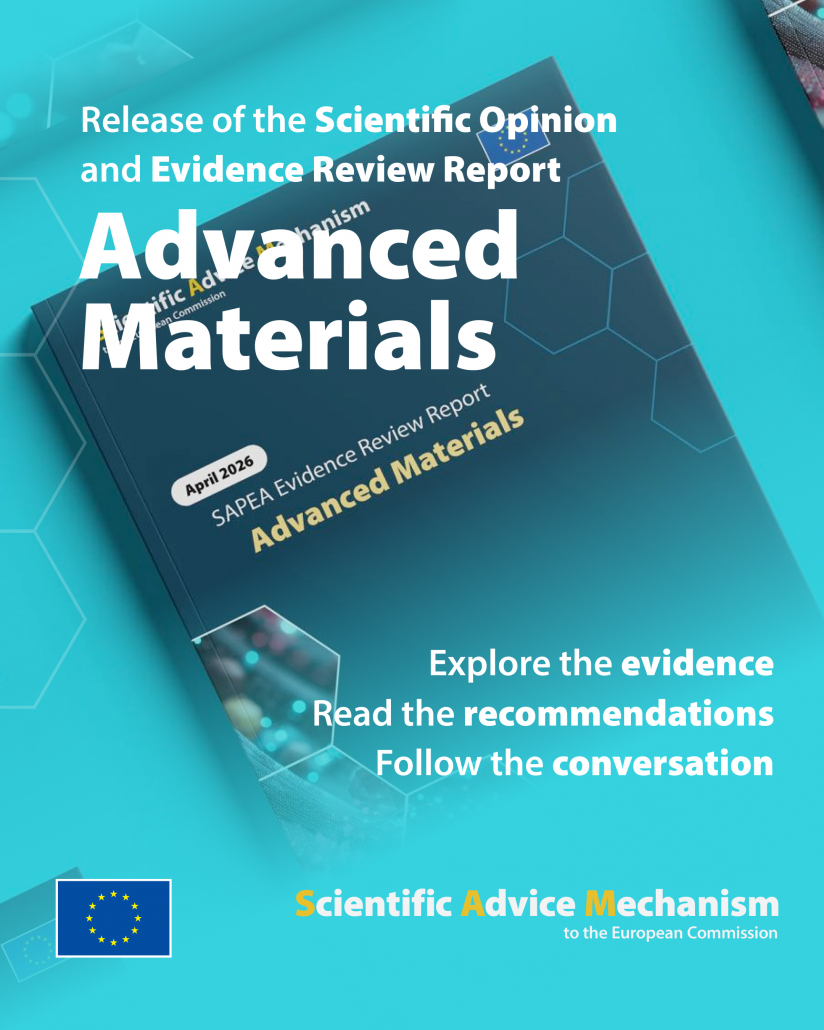
The EU Cannot Afford Fragmented Approach to Advanced Materials, Academies Advise European Commission
The Scientific Advice Mechanism (SAM) has advised the European Commission on how to strengthen Europe’s position in the development and deployment of advanced materials.
The Science Advice for Policy by European Academies (SAPEA), through its working group of renowned scientists nominated by European academies to work on the topic, played a pivotal role in this advice. The experts provided the overview of the current scientific knowledge on the topic — which the Group of Chief Scientific Advisors (GCSA) has used to inform their policy recommendations.
The SAPEA Evidence Review Report and the GCSA Scientific recommendations were submitted on 21 April in Brussels to Ekaterina Zaharieva, Commissioner for Startups, Research and Innovation.
The advice comes in support of the upcoming Advanced Materials Act.
Advanced materials, including superconducting materials for computers, biomaterials for drug delivery, and materials that store or distribute energy more efficiently, are designed to deliver superior performance for specific functionalities. These materials are essential for Europe’s autonomy, competitiveness, and resilience.
As co-chair of the SAPEA working group, Anke Weidenkaff, explains, “Europe leads in computational modelling and first-principles simulation codes, yet lacks the high-quality, specialised datasets needed for AI-driven discovery of more sustainable materials. Additionally, Europe’s fragmented cross-border economic ecosystems weaken its ability to compete with concentrated advanced materials manufacturing hubs elsewhere.”
Based on the evidence provided by SAPEA, the GCSA made a range of policy recommendations to the European Commission for advancing Europe’s advanced materials ecosystem, including:
- Safety and sustainability from the outset: Progressive criteria and standards should be applied, with increasing requirements as the technology comes closer
to market. - Circular economy and material substitution: Given geopolitical volatility and unreliable supply chains, the EU needs more circular systems that maximise
recovery and reuse of materials. - Digitalisation and FAIR data: The EU should develop common data languages, enforce FAIR (Findable, Accessible, Interoperable, and Reusable) data principles
across all research, and use AI to connect databases and benefit from existing scientific literature. - Standards as enablers: Europe’s strength in standards and regulation can become a competitive advantage, provided standards are designed to enable
rather than hinder innovation. Clear, applicable standards reduce time to market and build investor confidence. - Coordinated ecosystems: Transforming scientific advances into market-ready products requires closing the gap between research and industrial
manufacturing. The EU must strengthen connections between discovery, scaleup and manufacturing, provide more support to small and medium enterprises,
and harmonise regulatory approvals across the continent. - Support fundamental research: Investment must expand to include education pipelines and address training and skills shortages.
“Investment in fundamental research and human capacity is crucial. Fundamental science requires long-term, predictable funding without expectations of rapid returns,” concluded SAPEA co-chair Olli Ikkala.
The Scientific Advice Mechanism (SAM) provides independent scientific evidence and policy recommendations to the College of European Commissioners on any subject, including on issues that the European Parliament and the Council consider to be of major importance. The SAM comprises the Science Advice for Policy by European Academies (SAPEA), a consortium of academy networks that includes over a hundred academies, young academies, and learned societies, including ALLEA, whose role is to review and synthesise evidence and the Group of Chief Scientific Advisors (GCSA), seven eminent scientists whose role is to make policy recommendations.
For the full evidence review report and scientific opinion on Advanced Materials, visit the Scientific Advice Mechanism website. For more information, contact Justine Moynat.