
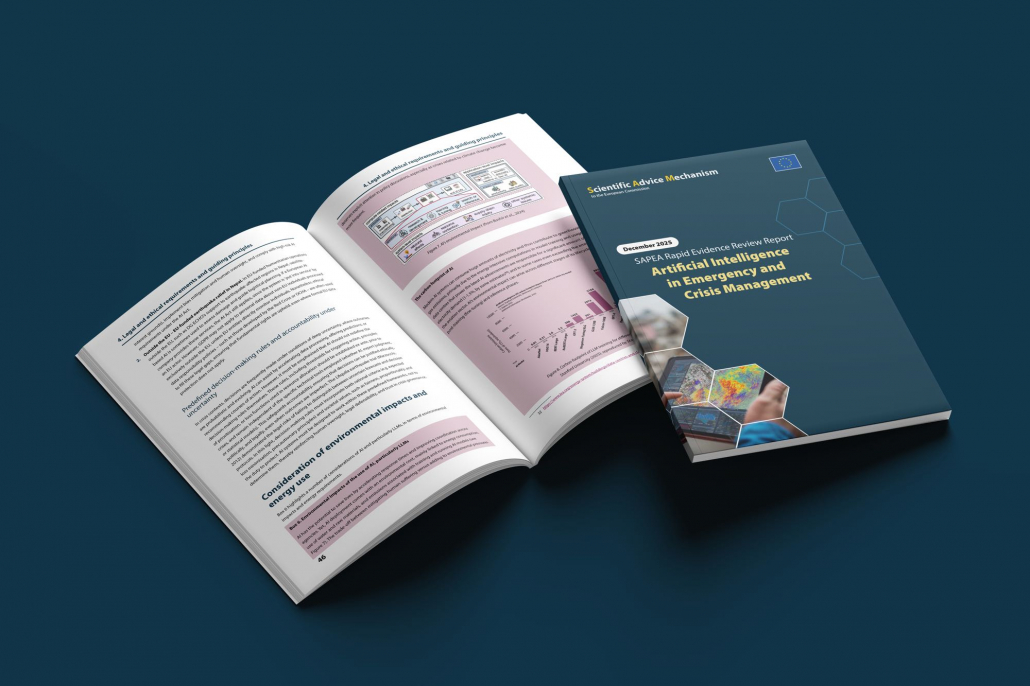
Academies Encourage the European Commission to Adopt a Careful and Ethical Approach to AI in European Crisis Management
A group of leading scientists nominated by the Academy Networks of SAPEA has provided advice to the European Commission on artificial intelligence in emergency and crisis management, through the Scientific Advice Mechanism. This advice underscores that artificial intelligence can significantly enhance emergency and crisis management across Europe through applications like early warning systems, damage assessment, and decision support, but requires careful ethical oversight, human control, standardized data frameworks, and recognition of its limitations in novel or morally complex situations.
Published on 11 December 2025, the Rapid Evidence Review Report was coordinated by ALLEA, on behalf of SAPEA.
“Over the past decade, the development and deployment of Artificial Intelligence have accelerated significantly. What was once confined largely to some research and industry sectors has now entered almost every aspect of our lives, thus becoming a societal, economic and political priority. Important debates and questions accompany the growing use of AI. One of those most pressing questions is how we can benefit from the full potential of these technologies, while also understanding and managing the risks that come with them”, said Prof. Paweł Rowiński, President of ALLEA, and Prof. Donald Dingwell, Chair of the SAPEA board.
Evidence suggests that AI performs best on standardised, data-intensive tasks typical in frequent disasters such as floods, wildfires, and droughts. It excels at repetitive monitoring tasks important for early warning systems and can process social media and assess damage at scales and speeds beyond the reach of human analysts. However, AI is not well suited to interpreting highly heterogeneous contexts or new situations where appropriate training data is lacking. Moreover, morally challenging decisions and trade-offs should not be referred to an AI tool.
The development and implementation of benchmarks, practical guidelines, codes of conduct and sandbox environments for AI in crisis management would allow the testing of AI under supervision and with ethical oversight, before full deployment. A new European crisis management data preparedness framework, with common standards and agreed sharing protocols, could help fill data gaps and promote data harmonisation between Member States, enabling the training of EU-wide AI for relevant EU contexts, and helping deliver better EU crisis management tools.
“Crises cross borders, but data is managed at the national level, leading to different standards. This diversity can lead to fragmentation in the data landscape that AI cannot easily bridge. Data preparedness is an important step to connecting these data systems that provide the necessary foundation for AI to provide effective decision support in European crisis management,” explained Professor Tina Comes, chair of the SAPEA working group on Artificial Intelligence in Emergency and Crisis Management.
The Scientific Advice Mechanism provides independent scientific evidence and policy recommendations to the European institutions by request of the College of Commissioners. It includes the Science Advice for Policy by European Academies (SAPEA) consortium, which gathers expertise from more than 100 institutions across Europe, and the Group of Chief Scientific Advisors (GSCA), who provide independent guidance informed by the evidence.
More information
Artificial Intelligence in Emergency and Crisis Management