
ALLEA at the Paris Conference on Strengthening Public Trust in Science – and First Meeting of New Task Force
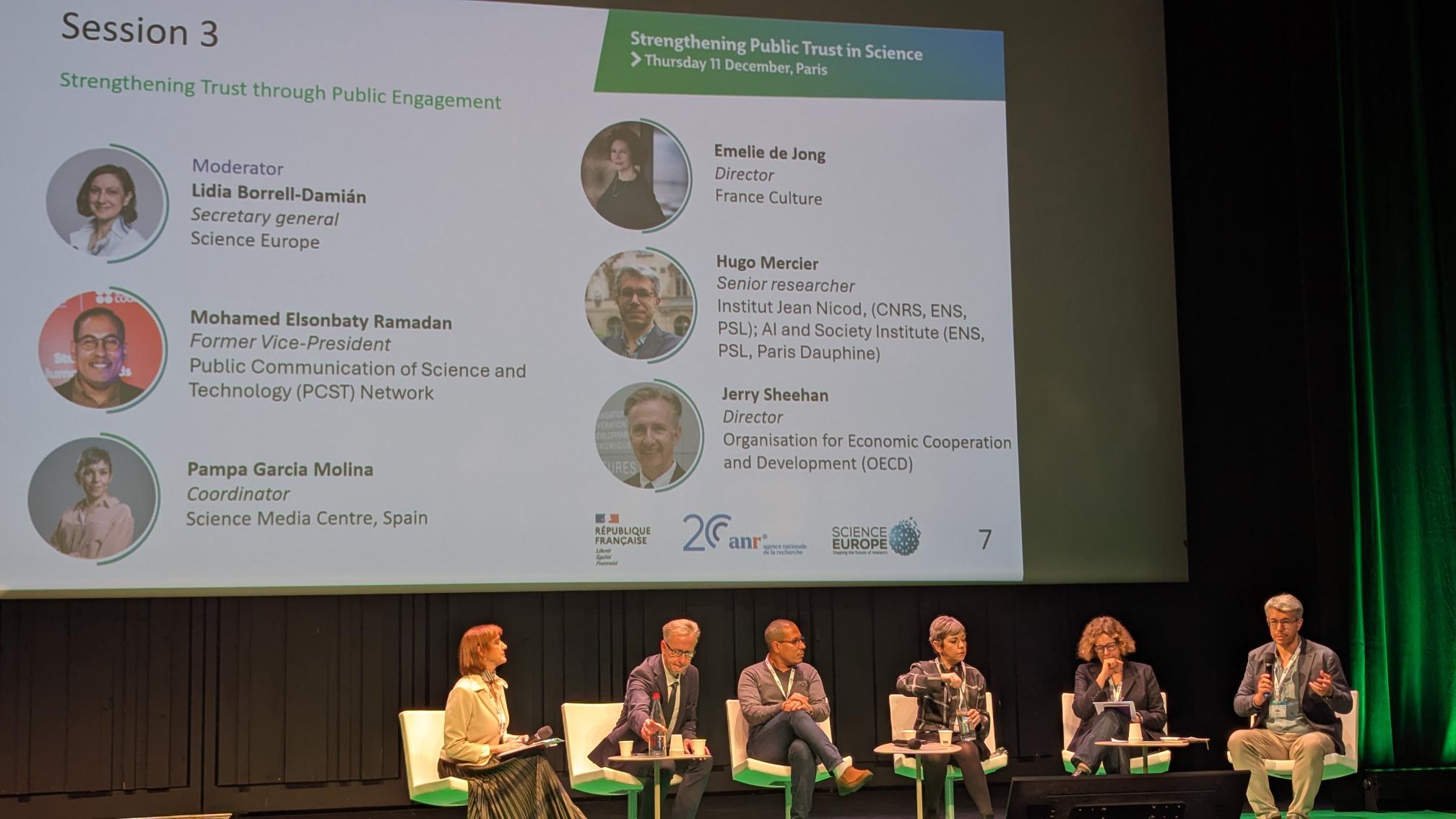
On 11 December, ALLEA joined policymakers, researchers, and science‐policy experts in Paris for a conference on Strengthening Public Trust in Science, co-organised by Science Europe and the French National Research Agency (ANR).
The event offered a timely and much-needed forum to reflect on one of the most urgent issues facing democratic societies today: how to safeguard and rebuild trust in science in an era of rapid technological change, global crises, and accelerating mis- and disinformation.
Public trust, as Science Europe Vice-President Javier Moreno Fuentes underlined in his opening, is “the glue that holds democratic societies together”. Yet this glue is coming undone. Trust is something we rarely think about – until it disappears. Modern societies are built on trust: it reduces transaction costs, enables complex cooperation, and allows (liberal and democratic) political systems to function. For decades, science has served as a key source of legitimacy and progress. Today, this role is increasingly contested.
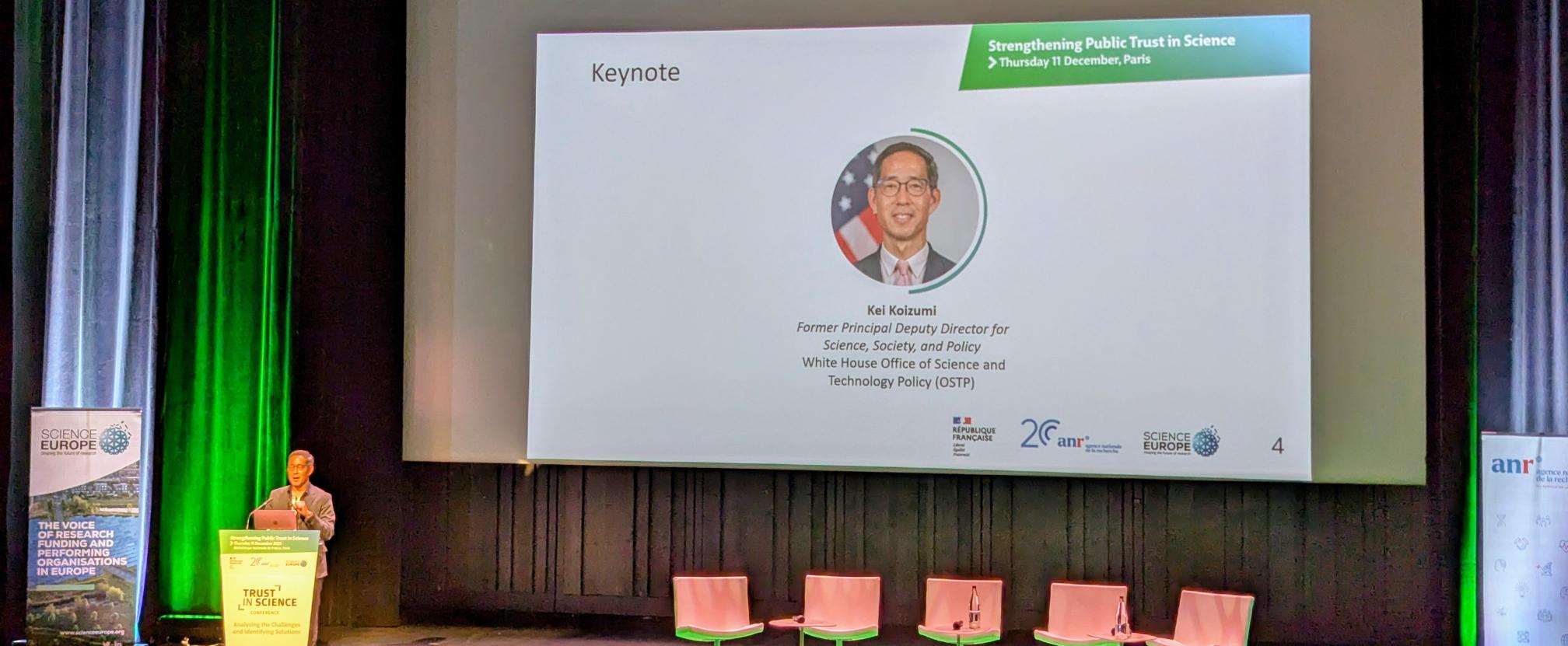
Kei Koizumi, Former Principal Deputy Director for Science, Society, and Policy in the White House Office of Science and Technology Policy (Biden Administration)
In a powerful keynote, Kei Koizumi offered an alarming assessment of developments in the United States, where deliberate political interference, widespread disinformation, and eroding information integrity are undermining confidence in public institutions and, indirectly, in scientific evidence. Although general trust in science remains comparatively high, deep divides between societal groups persist and increase, and trust in policy decisions informed by scientific advice has weakened. While the Covid-19 pandemic initially seemed to demonstrate the life-saving value of science, policy responses often had the opposite effect and fuelled polarisation.
Koizumi and other speakers emphasised that trust cannot be built through dissemination of information alone: effective communication requires dialogue, transparency, and teaching a different understanding of how science works – not as a fixed set of truths, but as a process grounded in the scientific method, integrity, and clearly defined values.
Some of the most renowned experts on trust in science in Europe further explored how fast-moving technologies – especially generative AI – may challenge traditional gatekeepers of knowledge, complicating citizens’ ability to distinguish evidence from misinformation and manipulation, how public engagement can strengthen trust in science, and the role trust in science plays at the science-policy interface.
Many of the proposed solutions echo long-standing priorities of ALLEA: strengthening research integrity, academic freedom, independent technology research, early science education, citizen engagement, and responsible science advice.
Inaugural Meeting of the ALLEA Task Force on Strengthening Trust in Science
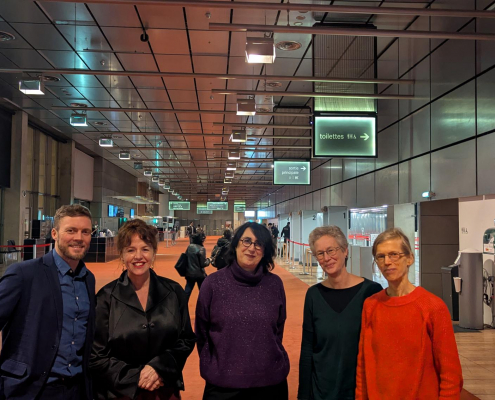
From L to R: Daniel Kaiser (ALLEA), Hedwig te Molder (KNAW), Daniela Ovadia (British Academy), Martina Feilzer (LSW), Tereza Stöckelová (Czech Academy of Sciences)
The conference provided an ideal backdrop for the first meeting of ALLEA’s newly established Task Force on Strengthening Trust in Science, held immediately afterwards. The hybrid meeting at the Bibliothèque Nacional de France brought together 17 experts from academies across Europe, representing a rich mix of disciplines, countries, and career stages, who will work closely with the ALLEA Board, the newly established Science-Policy Standing Committee, the Research Ethics and Integrity Council, and other Task Forces over the coming months.
The meeting introduced the Task Force’s purpose and set the stage for its future work. Members got to know each other and discussed the increasingly complex environment in which trust in science is shaped: the rapid spread of mis- and disinformation, the impact on evidence-informed policymaking, and the need to understand trust in science as part of broader societal dynamics. Participants stressed the importance of approaching the issue with curiosity rather than defensiveness; distrust, they noted, often stems from legitimate experiences and concerns that deserve attention. As Task Force Chair Emilija Stojmenova Duh (Global Young Academy) put it, “In a world where uncertainty is high and societal challenges are increasingly complex, trust in science has never been more important. Strengthening it is one of the most important tasks of our time, and I’m proud to contribute to this mission.”
The Task Force will play a prominent role in European-level discussions, including ALLEA’s involvement in the European Research Area (ERA) Structural Policy on “Enhancing Trust in Science through Citizen Participation, Engagement and Science Communication”, an initiative co-led by Germany and Sweden in the ERA Forum. The group agreed to meet regularly over the coming months, with the next session scheduled for January to refine its thematic focus and establish priority areas and topic leads.
“In a world where uncertainty is high and societal challenges are increasingly complex, trust in science has never been more important. Strengthening it is one of the most important tasks of our time, and I’m proud to contribute to this mission.”
-Emilija Stojmenova Duh, Chair, ALLEA Task Force on Trust in Science
For ALLEA and its Member Academies, strengthening public trust in science is not a new endeavour, but it is more urgent than ever. Together, the Paris conference and the launch of ALLEA’s new Task Force mark an important step in advancing evidence-informed, socially responsive, and trustworthy science across Europe at a time when it is needed most.