An open letter to the European Commission President Ursula von der Leyen signed by 25 European umbrella research and innovation organisations – including ALLEA – urges the European Commission and UK Government to work towards a successful UK association to Horizon Europe, “to safeguard this valuable and mutually beneficial R&I cooperation”.
The signatories call for moving forward the UK association to Horizon Europe “without further delay”:
“The EU knowledge community collectively welcomed the provision in Protocol I of the EU-UK Trade and Cooperation Agreement for the UK to associate to Horizon Europe. The subsequent Q&A document from the European Commission provided us with the reassurance that UK entities could apply with EU partners for the first multi-beneficiary calls.
Based on the Protocol and those reassurances, for the past 10 months our universities, businesses and research institutions have been working with UK partners with a shared vision and in good faith that the UK would soon be a full associate member.
But the absence of a clear timeline for finalising UK association is now causing increasing concern. This lingering uncertainty risks endangering current and future plans for collaboration.
We are rapidly approaching a crunch point. With the first Horizon Europe grant agreements approaching and new calls soon to be launched, UK association must be finalised without further delay.”
The joint letter brings together over 1,000 universities and universities of applied sciences, 56 academies of science, 38 research performing and funding organisations, 33 rectors’ conferences, as well as 120 regional organisations.
The signatories underline that the EU research programme Horizon Europe’s success will hinge on its commitment to excellence and global outlook. “The only way to move forward from the Covid-19 pandemic is as a global community working together to drive research and innovation through collaboration.”
https://allea.org/wp-content/uploads/2021/11/Horizon-Europe-joint-statement_visual_blank-text.png550950ALLEA Secretariathttps://allea.org/wp-content/uploads/2019/04/allealogo-1-300x83.pngALLEA Secretariat2021-11-04 10:17:402021-11-04 10:22:37ALLEA Signs Open Letter Calling for Finalising UK Association to Horizon Europe
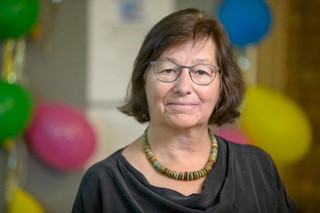
Kerstin Sahlin (Royal Swedish Academy of Science) is the Chair of the new ALLEA Working Group on the European Research Area. Picture credit: Umeå University/Mattias Pettersson
Professor Kerstin Sahlin (Royal Swedish Academy of Sciences) is Professor of Public Management in the Department of Business Studies at Uppsala University. She is also the Chair of the new ALLEA Working Group on the European Research Area, which held its first meeting on 7 October. The group will contribute to the further development of the ERA, its political framework, implementation and monitoring. In this interview, she provides us with an overview on the key issues at stake for the future of ERA.
Question: You are the chair of ALLEA’s new working group on the European Research Area. Could you tell us a bit about the objectives of this project?
Kerstin Sahlin: The group will address strategic issues of importance to accomplish the ERA such as free circulation, research inequalities and widening participation, young researchers, academic freedom, and global approaches to R&I. The programme of action will include engaging with the European Institutions, particularly the European Commission, on the development of the ERA, its implementation, monitoring and evaluation. The group will also continue to contribute to the monitoring and shaping of EU research and innovation framework programmes.
“The programme of action will include engaging with the European Institutions, particularly the European Commission, on the development of the ERA, its implementation, monitoring and evaluation.”
Q.: The European Research Area (ERA) was created in the 2000s as a mechanism to address the fragmentation of the EU’s research and innovation systems. After more than 20 years in development, could you mention one key achievement of this project and one relevant pending issue ahead of us?
K.S.: The European Research Area (ERA) is the ambition to create a single, borderless market for research, innovation and technology across the EU. In 2018, the European Commission initiated a process to revitalise the ERA and in 2020 launched what is called the new ERA. This new ERA seeks to strengthen mobility of researchers and the flow of knowledge, incentivise investing in research and innovation, promote gender equality and diversity in science, and enhance cooperation among universities, business and other research and innovation actors.
Q.: After the recent Communication of the European Commission on the future of ERA and the new EU Pact for Research and Innovation, the new ERA is taking off. In your opinion, is the ambition and the framing of priorities of this policy initiative moving towards the right direction?
K.S.: In general, we are very positive to the ambitions of strengthening the European Research Area. The new ERA – and the EU pact for Research and Innovation that was formulated as an agenda for the new ERA – includes a long list of topics. It is still a very open and complex process. The programme of action will include engaging with the European Institutions, particularly the European Commission, on the development of the ERA, its implementation, monitoring and evaluation.
“We want to see a new ERA that facilitates cooperation, improves framework conditions for science and research across Europe, facilitates good research practice (…)”
Q.: In which areas can European academies work together to contribute the most to the future of the new ERA?
K.S.: We want to see a new ERA that facilitates cooperation, improves framework conditions for science and research across Europe, facilitates good research practice, defends academic freedom and trustworthy science, strengthens diversity and inclusivity, and helps us think and act globally. An ERA, in other words, that forms along the strategic priorities of ALLEA.
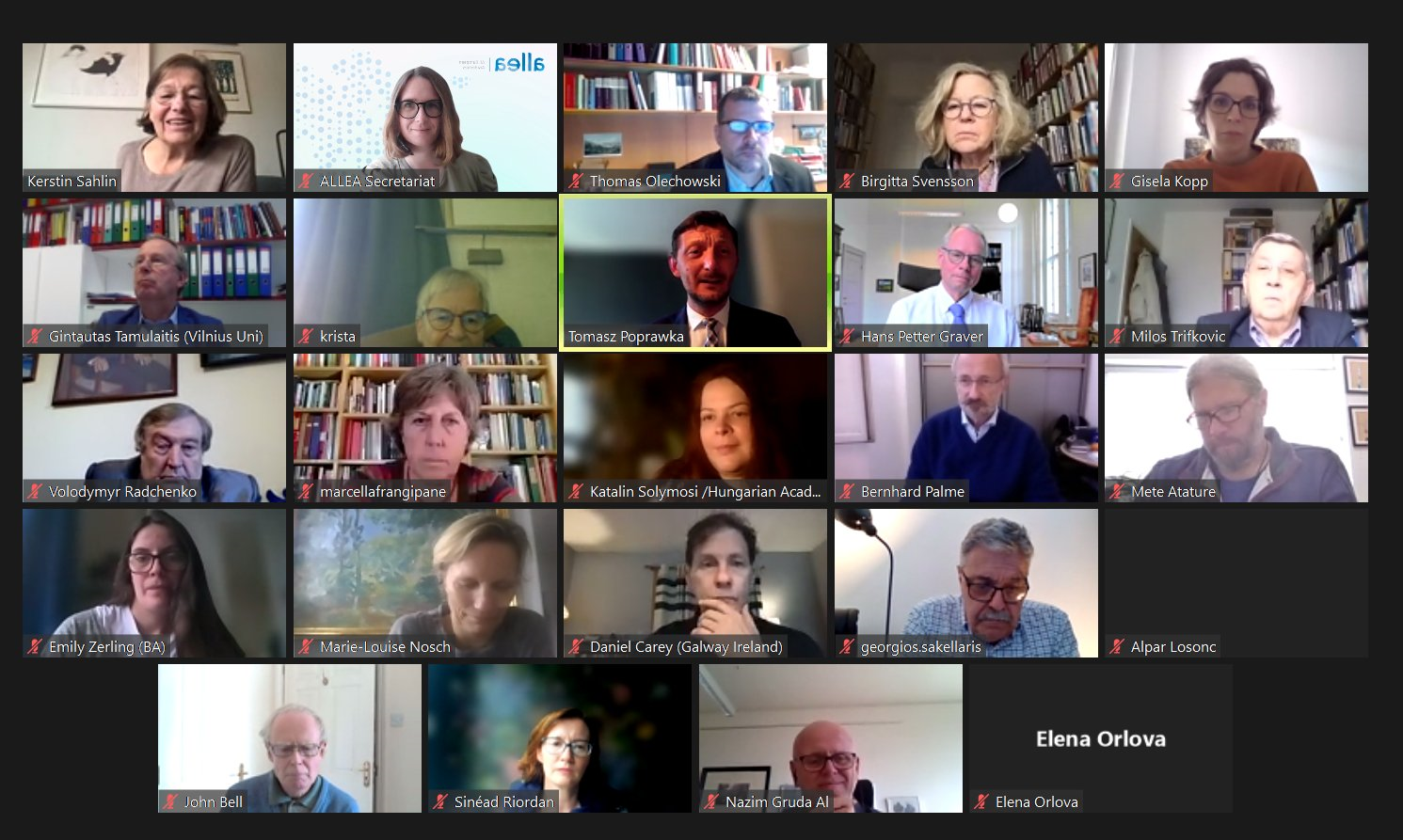
Members of the new ALLEA Working Group on the European Research Area in their first meeting on 7 October, 2021. The breadth of expertise and geographical representation of the group’s membership reflects the heterogeneity of the ERA itself.
Q.: An often-antagonising debate among scientists is the role citizens and policymakers should play in defining their research agendas. How do you think this question should be addressed?
K.S.: I think most researchers welcome an openness to citizens and policymakers. Of course, this should not be set up in such a way that the independence, freedom and trustworthiness of science and research is compromised.
Q.: You are Professor of Public Management at Uppsala University. Could you tell us about your main research interests?
K.S.: I have studied various aspects of organizing and governing public sector organizations. My interest has mainly concerned organizational reforms, the global expansion and circulation of management ideas and developments of global standards and regulations. I am also interested in public – private relations and in the social responsibility of corporations. More recently I have largely focused my research interest on the governing and organizing of higher education and research.
Q.: What is the latest project you have been working on?
K.S.: I currently conduct an international comparative study on collegiality in the governance and organizing of higher education and research.
Cover Picture Credit: Shutterstock
https://allea.org/wp-content/uploads/2021/10/Future-European-Research-Area.jpg4041197ALLEA Secretariathttps://allea.org/wp-content/uploads/2019/04/allealogo-1-300x83.pngALLEA Secretariat2021-10-22 11:51:272024-03-26 14:27:33Towards a New European Research Area — Interview with Kerstin Sahlin
On 2 September, ALLEA participated in a workshop on the future governance of the European Research Area (ERA) organised by the Permanent Representation of Slovenia to the EU in Brussels. The event is part of the programme of the Slovenian Presidency of the Council of the European Union.
The workshop addressed the ongoing policy discussions on the future framework of the ERA, the flagship policy of the European Commission to create a “single, borderless market for research, innovation and technology across the EU”.
ALLEA was represented by its Board member Maarten Prak (Royal Netherlands Academy of Arts and Sciences, KNAW) and member of the Horizon Europe Working Group. The workshop was attended by a variety of stakeholders representing the Research and Innovation community.
The workshop addressed the options of an expanded policy framework of the ERA and the redesign of its multi-level governance, including in particular the reinforced involvement and dialogue of reasearch stakeholders with policymakers.
A New ERA
In 2020, the European Commission published a Communication to set up new priorities and to tackle new challenges for research in Europe. Its ambition is to revitalise the project and transform it to match generational changes and to draw on the lessons from the Covid-19 pandemic crisis.
The foundations for a new ERA are being laid with the Pact for Research and Innovation. On 16 July, the European Commission adopted its proposal for a Council Recommendation on “A Pact for Research and Innovation in Europe” to support the implementation of national European Research Area (ERA) policies.
ALLEA is contributing to these policy developments through its long-standing network of experts on research policy. In August 2020, ALLEA submitted a response to the European Commission’s public consultation on the future of the ERA. Our federation has supported and offered advice on the construction and shaping of the ERA since its beginnings.
https://allea.org/wp-content/uploads/2021/09/European-Research-Area.jpg4001313ALLEA Secretariathttps://allea.org/wp-content/uploads/2019/04/allealogo-1-300x83.pngALLEA Secretariat2021-09-06 11:49:322024-03-26 14:27:46ALLEA Participates in Workshop on the Future of ERA Governance