
ALLEA Board Member Contributes to
Leopoldina Podium Discussion on
Science in Democracy
03. September 2026
On 1 September 2026, ALLEA Board Member Kerstin Pahl joined a wide-ranging Leopoldina panel discussion in Halle (Saale) on the relationship between science and democracy under growing authoritarian pressure.
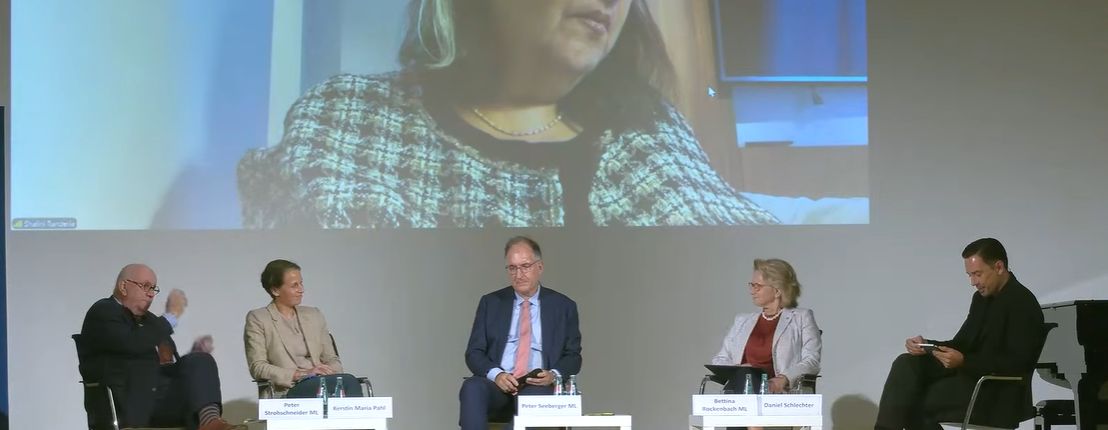
On 1 September 2026, the German National Academy of Sciences Leopoldina hosted a public podium discussion, “Science in Democracy,” addressing a question that has been growing with urgency across Europe: what does free, open-ended research mean for a democratic society put under strain? ALLEA Board Member Kerstin Pahl, representing Die Junge Akademie, joined the panel alongside Leopoldina President Bettina Rockenbach, founding director of the Center for the Transformation of Chemistry (CTC) Peter Seeberger, and former president and rector of the Central European University and current Excellence Chair at Bremen Univiersity Shalini Randeria (joining remotely), with a keynote from Peter Strohschneider, the Academy’s Research Curator for the integration into the European Research Area.
Opening keynote: freedom to search, not to possess truth
Strohschneider opened the evening by challenging the common assumption that science and liberal democracy are naturally “kindred” forces. He proposed instead that their relationship deserves closer scrutiny, offering four theses: 1) scientific freedom protects the search for truth rather than the possession of it, meaning science must remain open to revision; 2) democratic decisions must be both substantively sound and majority-legitimate, and these two demands can conflict; 3) the defining trait shared by science and democracy is reversibility, meaning that both must remain open to future correction, unlike authoritarianism’s claim to finality; and 4) defending both science and democracy against authoritarian threats requires genuine self-reflection rather than simple defense of the status quo.
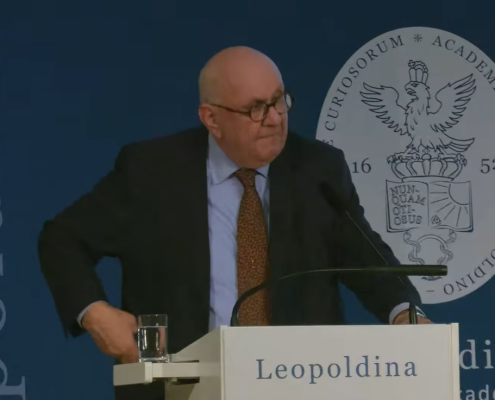
Peter Strohschneider, the Leopoldina’s Academy’s Research Curator
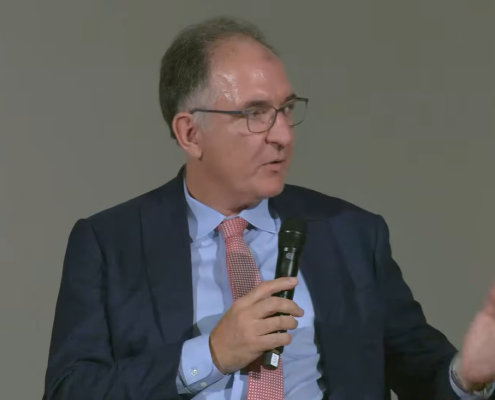
Peter Seeberger
Who needs whom more?
Opening the panel, moderator Daniel Schlechter posed a deliberately provocative question: does science need democracy more, or does democracy need science more? Responses throughout the panel discussion varied by discipline and framing, providing a broader view of thought. Seeberger noted that while science can exist under authoritarian conditions, democracy struggles without it. Pahl emphasized the Humanities’ role as a critical-thinking space that is core to democracy itself. Randeria distinguished between science and the university: while some fields, like theoretical physics, can flourish under authoritarian conditions, disciplines like history and literary studies suffer when research content becomes politically prescribed. In this context, the autonomy of universities is a democratic necessity in a way that “science” broadly isn’t.
The Central European University case
Randeria offered a detailed account of Hungary’s 2017 law that indirectly forced the Central European University out of Budapest. This removal was not through an outright ban, but through deliberately engineered legal uncertainty. She described the aftermath: Hungarian public universities were converted into foundations controlled by government-aligned boards, the Hungarian Academy of Sciences’ research institutes became dismantled and redistributed, and a slow, partial EU response resulted. As an example, a European Court of Justice ruling took four years and ultimately rested on trade law rather than academic freedom, while the EU’s decision to cut Erasmus access for Hungarian public-university students inadvertently penalized the very students seeking exposure to academic freedom elsewhere when they could not find it at home.
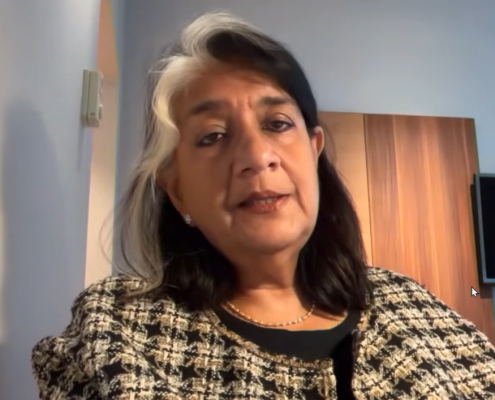
Social Anthropologist Shalini Randeria
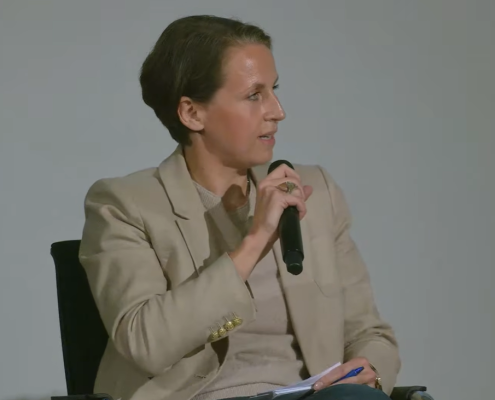
ALLEA Board Member Kerstin Pahl, representing Die Junge Akademie
Academies as Strongholds for Academic Freedom
Kerstin Pahl also highlighted the case of the Hungarian Academy, an ALLEA member, brought up by Randeria before as an example for the infringement of academic freedom. She explained that the removal of research institutes from the Hungarian Academy of Sciences in 2019, which placed them under state control, demonstrated the particular vulnerabilities of research institutions. At the same time, she pointed to a revival of academies as important actors in safeguarding academic freedom, arguing that they can serve as resilient institutions and provide a strong collective voice. This is particularly valuable for early-career researchers, many of whom work on temporary contracts and may therefore be more vulnerable in public and academic discourse. Pahl argued that academies can strengthen their position by facilitating networking, collective action, and international connections, while also creating spaces for dialogue between actors with differing relationships to state funding.
Gender studies as a political target
An extended exchange addressed why certain disciplines, particularly gender studies, have become recurring targets. Pahl noted that such criticism predates current political movements, pointing to the “grievance studies” label and Sokal-style hoax submissions from the 1990s. Prof. Randeria argued more pointedly that attacks on gender studies form part of a broader authoritarian pattern. This pattern connects ethnonationalism, demographic anxiety, anti-immigration policy, and pronatalist family politics, and Randeria cited examples from Austria, Hungary, and the United States.
Institutional resilience versus solidarity
Toward the end of the discussion, the question on whether academic resilience should rest on institutional safeguards or civil-society solidarity arose. To explore this thought, Randeria contrasted Hungary’s 2017 mass protests (which offered moral support but limited practical protection) with tactics used against individual universities in the United States. She characterized these actions as a strategy of division. In turn, Randeria proposed a form of mutual-defense pact among universities, describing it as “a NATO for universities,” operating at both national and European levels.
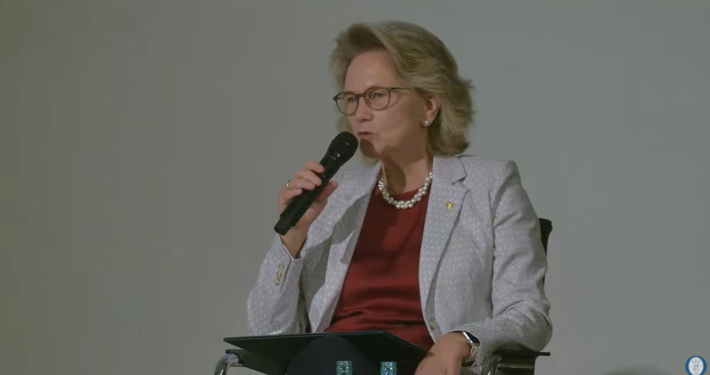
Leopoldina President Bettina Rockenbach
Closing reflections
In closing remarks, Rockenbach stressed that scientific freedom is not merely a matter of comfort for researchers. Data left unmeasured during periods of institutional disruption, such as climate or medical data, can never be recovered, with consequences broadly impacting society.
Seeberger argued that scientists must actively demonstrate their societal relevance to remain publicly anchored.
Pahl highlighted Die Junge Akademie’s ongoing “Proofing the Academy” project, examining how universities can build both resilience and rapid solidarity mechanisms, and cautioned against a “professors are the enemy” framing, calling instead for deliberate trust-building between science and society.
Strohschneider argued that solidarity is most credible when scientists defend other disciplines’ interests, not only their own.
Randeria’s final remarks warned that disproportionate attacks on academia can distract from larger societal issues such as economic inequality, and proposed distinguishing between what universities are good at (excellence) and what they are good for (social relevance). Randeria argued that the two must be reconciled rather than played against one another in order for a balance that progresses society forward can be found.
The full discussion is available to watch online: Leopoldina: Science in a Democracy
You can also watch the full recording (original in German) here: Watch the recording here or view in the player below.