Archive for category: Research Security

ALLEA Task Forces Meet in London to Discuss Academic Freedom, Research Security, and Data Protection

On 15 June, the ALLEA Task Forces on Integrating Research Security and Academic Freedom and on Protecting and Sharing Data held hybrid meetings in London, hosted by the Royal Society and King’s College London.

The meeting brought together 17 experts – virtually and in person – to navigate the increasingly complex intersections of Open Science, institutional safety, and geopolitical pressures in rapidly changing research environments.  

During the morning sessions, the Task Force on Integrating Research Security and Academic Freedom evaluated the rise of government oversight over federally funded research. Members of the task force contrasted prescriptive international regulations with empowering, risk-management approaches. They analysed how economic security complicates national security definitions, and explored distinct disciplinary challenges, such as dual-use export controls in applied sciences versus transnational repression in the humanities.

In parallel, the Task Force on Protecting and Sharing Data discussed the responsible and resilient use of artificial intelligence (AI) in research, focusing on risks like commercial tool dependency and data poisoning (the intentional and malicious injection of corrupted, biased, or false information into an AI or machine learning model’s training dataset). They also addressed urgent European Commission consultations regarding Text and Data Mining (TDM) rights, open access frameworks, and the friction between the General Data Protection Regulation (GDPR) and academic research. This task force is currently drafting a statement on generative AI and research integrity. 

This was followed by a joint session, during which the task forces assessed strategic synergies, examining how data protection, trust, and transparency overlap with research security. Their dialogue emphasised that bolstering internal data security and collaboration is essential for protecting trust among researchers. They further concluded that better communication of the broad societal value of academic freedom is crucial for safeguarding public trust in science. To bridge their respective mandates and move their work forward, the task forces committed to ensuring a regular knowledge exchange. 
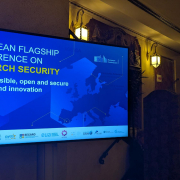
ALLEA Co-Organises Flagship Conference on Research Security

From 28-30 October, ALLEA co-organised the European Flagship Conference on Research Security in Brussels, together with the European Commission and 11 other partners.

ALLEA Calls For Balanced And Secure International Research Collaboration In A Changing World

In a statement published today, ALLEA, the European Federation of Academies of Sciences and Humanities, highlights the urgent need to safeguard openness, research integrity, and academic freedom in international research collaborations while addressing emerging security concerns in a rapidly and radically changing geopolitical landscape.

As a longstanding advocate for open and responsible science, ALLEA urges European and national policymakers, research funders, and academic institutions to adopt a harmonised and principles-based approach to research security.

“Europe must find a balanced path that manages risks without undermining academic freedom and scientific progress,” said Professor Pawel Rowinski, ALLEA President and a lead contributor to the statement. “This is not just about protecting research—it’s about protecting the values that underpin it.”

Towards a European Framework for Research Security

ALLEA’s statement welcomes established frameworks like the EU Council Recommendation on Enhancing Research Security and builds on extensive exchange with its Member Academies, the scientific community, and European Institutions. It offers a distinctly European perspective on navigating the complexities of international collaboration in an increasingly fragmented geopolitical landscape.

The statement stresses the importance of capacity building and harmonised rules within the European Research Area (ERA) to empower researchers and institutions. Seeking to tackle the enormous global challenges by enabling sustainable and secure international scientific partnerships in a responsible manner, it calls for creating fair conditions of equitable access to research security resources and clarifying responsibilities.

Integrating Freedom and Responsibility

While academic freedom remains a cornerstone of science, ALLEA underscores that it comes with responsibilities. Researchers and institutions must carefully evaluate potential risks while adhering to principles of research ethics and integrity.

“Research security frameworks must not close doors but enable informed choices, allowing science to thrive without compromising its openness,” said ALLEA Vice President Marie Louise Nosch, another principal contributor.

Key Recommendations from ALLEA’s Statement:

  • Balancing Openness and Security: Research policies must integrate openness with robust security measures to mitigate risks without restricting academic freedom.
  • Harmonised Rules Across Europe: ALLEA calls for a unified framework across the ERA to provide consistency and clarity for researchers and institutions.
  • Capacity Building: Policymakers and institutions must invest in tools and training that equip researchers at all career stages to manage collaboration risks effectively.
  • Guidance for Sensitive Partnerships: ALLEA advocates for clear guidelines to support collaborations in environments that may not fully respect academic freedom or institutional autonomy.

ALLEA’s Commitment

This statement, developed by a dedicated task force alongside the ALLEA Working Group on the European Research Area, reflects ALLEA’s ongoing commitment to fostering science as a global public good. Through its work, ALLEA continues to promote secure, inclusive, and globally relevant scientific collaboration.

This statement builds on the key topics discussed at the ALLEA General Assembly in May 2024 in Berlin, where a major focus was responsible internationalisation in science. Specifically, the discussion centered on how to encourage and foster international research collaborations during times of geopolitical crises, while preventing the misuse of science and technology. To this end, ALLEA invited insightful comments from experts, including Juras Banys (President of the Lithuanian Academy of Sciences and ALLEA Board Member), David Harel (President of the Israel Academy of Sciences and Humanities), Mark Walport (Foreign Secretary of The Royal Society), Yves Flückiger (President of the Swiss Academies of Arts and Sciences), Antonio Loprieno (Former ALLEA President), and Pawel Rowinski (ALLEA President), in a video discussion:


The full statement, “ALLEA Statement on Research Collaboration and Research Security in a Shifting Geopolitical Landscape,” is available here.