Ukraine Coalition Meeting Explores Pressing Challenges and Sets Priorities

On 9 December 2025, ALLEA joined the first technical meeting of the International Coalition for Science, Research and Innovation in Ukraine, contributing perspectives from Europe’s academies and reinforcing its ongoing support for Ukrainian researchers and institutions.

ALLEA participated in the first technical-level meeting of the International Coalition for Science, Research and Innovation in Ukraine, launched in summer 2025 by the European Commission and UNESCO, among others, to coordinate global support for Ukraine’s research and innovation system.

The meeting provided an opportunity for coalition partners to explore in depth the pressing challenges faced by researchers and innovators in Ukraine, including sustaining scientific work under wartime conditions, addressing institutional needs, and fostering brain circulation to ensure that Ukrainian talent remains connected to the national research system. Members also reviewed ongoing support actions and discussed potential next steps to strengthen collective responses.

Representing the European academies, ALLEA Director Matthias Johannsen highlighted the organisation’s longstanding commitment to supporting Ukrainian science:

“ALLEA is proud to be a member of the Coalition, representing the community of European Academies in supporting Ukrainian science and research. We are grateful to the Coalition Secretariat for the valuable insights, discussions, and strong engagement during this first technical meeting.”


Past and ongoing support

ALLEA’s support for Ukraine builds on significant past and ongoing efforts. Notably, the European Fund for Displaced Scientists (EFDS) – initiated by ALLEA thanks to a grant from the U.S. American Breakthrough Prize Foundation – has provided direct assistance to Ukrainian researchers displaced by the war, as well as those who remained in the country despite adverse conditions. In addition, ALLEA maintains close cooperation with its member, the National Academy of Sciences of Ukraine, ensuring that Ukrainian scientific institutions remain connected to European and global research networks.


About the Coalition

The International Coalition for Science, Research and Innovation in Ukraine brings together governments, research organisations, funding agencies, and international partners to ensure coordinated and sustained support for Ukraine’s research and innovation ecosystem during the war and throughout reconstruction.

ALLEA will continue to work closely with coalition partners and the National Academy of Sciences of Ukraine to help safeguard Ukraine’s scientific capacity, strengthen collaboration, and contribute to the country’s long-term recovery and integration into the European Research Area.

ALLEA Joined the Newly Launched International Coalition to Support Ukraine’s Research and Innovation Ecosystem 

An International Coalition for Science, Research, and Innovation in Ukraine was officially launched in Rome on 11 July during the 2025 Ukraine Recovery Conference. The joint initiative by the Italian Ministry of University and Research, the Ukrainian Ministry of Education and Science, UNESCO and the European Commission, marks a significant step in placing science, research and innovation at the heart of Ukraine’s sustainable, inclusive and long-term recovery. 

The launch was announced by the Italian Minister of University and Research, Anna Maria Bernini; the Ukrainian First Deputy Minister of Education and Science of Ukraine, Yevhen Kudriavets; the European Commissioner for Startups, Research, and Innovation, Ekaterina Zaharieva; and UNESCO’s Assistant Director-General, Lidia Arthur Brito. 

ALLEA is pleased to announce that it has joined the Coalition, which aims to respond to both the urgent needs and long-term priorities of Ukraine’s research and innovation system. The initiative will promote concrete actions to support Ukrainian scientists, drive reconstruction and modernisation, and reinforce the role of research and innovation in the country’s recovery.  

As the European umbrella organisation representing 60 academies from over 40 countries, ALLEA has consistently advocated for the protection and advancement of scientific cooperation, academic freedom, and the integration of displaced and at-risk researchers. Since the start of Russia’s war of aggression against Ukraine, ALLEA and its Member Academies have been actively involved in initiatives to support Ukrainian researchers, such as through the partnership with The Breakthrough Prize Foundation, strengthen institutional resilience, and foster international scientific collaboration. 

ALLEA shares the Coalition’s commitment to sustaining and rebuilding Ukraine’s research and innovation system. Furthermore, ALLEA’s broad European network and expertise in science policy can contribute meaningfully to the Coalition’s objectives and advance opportunities for joint actions to: 

  • Support mobility and integration of Ukrainian researchers in European research networks, 
  • Facilitate knowledge exchange and institutional capacity-building, and 
  • Promote the long-term reintegration of Ukrainian science into the European and global research community. 

Membership in the Coalition is open to governments, international organisations, research entities, academic institutions, foundations, development banks and private sector actors actively supporting Ukraine’s research sector. Interested entities are invited to join by agreeing to adhere to the Rome Declaration and submitting a formal request to the Secretariat at EC-R-I-COALITION-UA-SECRETARIAT@ec.europa.eu. 


ALLEA Reaffirms Solidarity with the Ukrainian Science Community After Three Years of War

Three years have passed since the beginning of Russia’s illegal war of aggression against Ukraine—a period marked by atrocities against the Ukrainian people and immense challenges for its scientific community. ALLEA reaffirms its unwavering solidarity with Ukraine’s scholars and scientists and with its academic institutions, especially our member, the National Academy of Sciences of Ukraine.

Since the conflict began, ALLEA has taken a clear and principled stance supporting Ukraine’s academic sector, while advocating for accountability and justice within the international scientific community. In response to the crisis, we implemented the European Fund for Displaced Scientists (EFDS), which provided essential resources to Ukrainian researchers forced to flee their homes, as well as to Ukrainian scientific institutions to continue their research efforts amidst the war. Collaborative efforts, such as our conferences with the International Science Council (ISC), further provided platforms to address the ongoing challenges faced by the Ukrainian academic system and to foster global solidarity.

ALLEA remains committed to long-term initiatives like the 10-Point Action Plan to Support the Ukrainian Academic System, which outlines essential steps for preserving and rebuilding Ukraine’s scientific infrastructure. As ALLEA President Paweł Rowiński stated, “It is our shared responsibility to ensure that Ukrainian researchers are supported not only in the short term but also as part of broader efforts to sustain and rebuild their academic institutions.”

On this sombre occasion, ALLEA reaffirms its commitment to support the resilience and perseverance of Ukraine’s scientific community. We will continue to stand with Ukrainian researchers and institutions, advocating for their freedom, safety, and ability to contribute to the global scientific endeavour.

2nd Ukraine Conference Report Published

Over three days in March 2023, ALLEA and the ISC hosted a second conference on the Ukraine crisis, ‘One year of war in Ukraine: Exploring the Impact on the Science Sector and Supporting Initiatives’. 

Held one year after the start of the full-scale assault on Ukraine, the conference and corresponding report sought to engage with the insights and recommendations that emerged from the previous conference held in June 2022. The aim was also to place them in the broader context of how and why the international science system and research community can show solidarity in times of crisis. The conference report affirms the validity of the recommendations of the June 2022 conference, and underlines considerations based on the worsening situation in Ukraine.

The online conference brought together over 530 participants from around the world with sessions hosted by Science Europe, National Research Foundation of Ukraine, The Council of Young Scientists, and the Ministry of Education and Science for Ukraine. The three-day event mobilised the scientific community to evaluate the protection and support efforts implemented during the past year while assessing further steps toward enhanced support and post-conflict reconstruction.

Read the full report

The Ukraine-Australian Research Fund Call for Applications is Now Open


Call for Applications open until 31st May 2023.

The Australian Academy of Science has partnered with the Breakthrough Prize Foundation to deliver a program to support Ukrainian researchers in eligible fields of science who have been impacted by the war with Russia. The donation is being used to establish two different activities, each designed to offer practical support to enable the continuation of research and technology activities by Ukrainian scientists.

Activity 1 – Short-term visits

The first activity (Activity 1) will support Ukrainian researchers to participate in short-term visits to Australia to engage in project research at a host institution, or to participate in a conference and site visit program. The Australian host organisation is responsible for applying for the funding and administering the grant to cover the direct costs to support the visit. More details on eligibility criteria, application, assessment, and terms of the award can be found here.

Activity 2 – Facility access

The second activity (Activity 2) provides practical support to research being undertaken in Ukraine that has been impacted by the current war. Under this activity, Ukrainian researchers can access leading infrastructure capabilities in Australia, such as supercomputing facilities, microscopy and microanalysis, and telescopes. Ukrainian researchers will be able to send their samples to National Collaborative Research Infrastructure Strategy (NCRIS) facilities for analysis, with the results returned to the Ukrainian research institute. Funding will cover the cost of sending samples between Ukraine and the Australian testing facility, and the cost of testing and analysing the samples. This activity will keep Ukrainian researchers productive and publishing at their own institutes in Ukraine while also engaging in international collaborations. More details can be found here.

For more details on the application process for both activities, visit the Australian Academy of Science’s page here. You can also read the FAQs for more information.

2nd Conference on the Ukraine Crisis: One Year of War in Ukraine, Exploring the Impact on the Science Sector and Supporting Initiatives

ALLEA and the International Science Council (ISC) will host the Second conference on the Ukraine crisis: One year into the Ukrainian war, exploring the impact on the science sector and supporting initiatives on 20-22 March. This event is a follow-up to the first conference, which took place in June 2022.

ALLEA Announces First Results of Support Programme for Ukrainian Science

The European Fund for Displaced Scientists Programme (EFDS) was set up to provide financial support for Ukrainian scientists and institutions that have been affected by the war. A total of up to 100 Ukrainian scientists will benefit from the programme.

Last March, ALLEA, the European Federation of Academies of Sciences and Humanities, announced the launch of the European Fund for Displaced Scientists Programme (EFDS) to assist the Ukrainian scientific community as a response to the ongoing Russian invasion. The programme was set up in partnership with the Breakthrough Prize Foundation who donated USD1.5 million for the launch of the programme.

The EFDS Programme consists of two separate funding lines: Funding Line 1 provides funds to academic institutions within the Council of Europe region that are able to host displaced scholars from Ukraine; Funding Line 2 provides funds to Ukrainian academic institutions for the continuation and/or reinstatement of their scientific operations and research collaborations, as well as to support initiatives that facilitate the reintegration of researchers upon their return to Ukraine.  A total of up to 100 Ukrainian scientists will benefit from the EFDS Programme through the combined funding of both lines.

ALLEA President Antonio Loprieno stated that “the remarkably large number of applications received by ALLEA under both funding lines is a clear indication of the need that exists for the EFDS Programme and similar schemes to assist Ukraine’s research community, particularly for institutions within Ukraine to support the country’s effort to maintain its scientific operations and avoid an irreversible loss of talents and skills.”

Under Funding Line 1, financial support was provided to set up new or maintain existing positions for displaced researchers from Ukraine during the war. Institutions were eligible to apply for up to €25,000 for a period of 12 months. ALLEA received a total of 244 applications from 23 countries under this Funding Line, of which 35 beneficiaries were finally selected due to funding limitations. The grants will be distributed to academic institutions from eleven different countries, including Austria, France, Germany, Hungary, Italy, Latvia, the Netherlands, Poland, Portugal, Spain, and Sweden.

The application process took into account the measures planned by the host institutions to avoid brain drain and support the beneficiaries to return and reintegrate into the Ukrainian academic system upon completion of the hosting arrangement. Particular attention was given to scholars from areas that had been most affected by the war or that were under ongoing fire. Priority was also given to scholars who are affiliated with institutions that had to relocate as a result of the war or institutions with heavily damaged research infrastructure, which would make it impossible for them to continue their research work in Ukraine.

Under Funding Line 2, Ukrainian institutions were eligible to apply for up to €75,000 for a period of 12 months. ALLEA received a total of 105 applications from 89 institutions within Ukraine. Of these, 6 applications were selected, which will directly support a total of 64 Ukrainian scientists from both the university and the academy sector to continue their work in Ukraine. Funds will mainly be used to cover the costs of institutional staff and to purchase critical research equipment and materials.

The evaluation and selection process for both funding lines was carried out by an independent selection committee composed by senior officials from international and pan-European scientific institutions representing universities, funding organisations and researchers, including the European Research Council, the European University Association, the Global Young Academy, and Science Europe.

More information about the EFDS programme can be found here.


__

About ALLEA

ALLEA is the European Federation of Academies of Sciences and Humanities, representing more than 50 academies from about 40 countries in Europe. Since its foundation in 1994, ALLEA speaks out on behalf of its members on the European and international stages, promotes science as a global public good, and facilitates scientific collaboration across borders and disciplines.

www.allea.org


For media inquiries

Emily Pollak

Corporate Communications Officer

pollak@allea.org


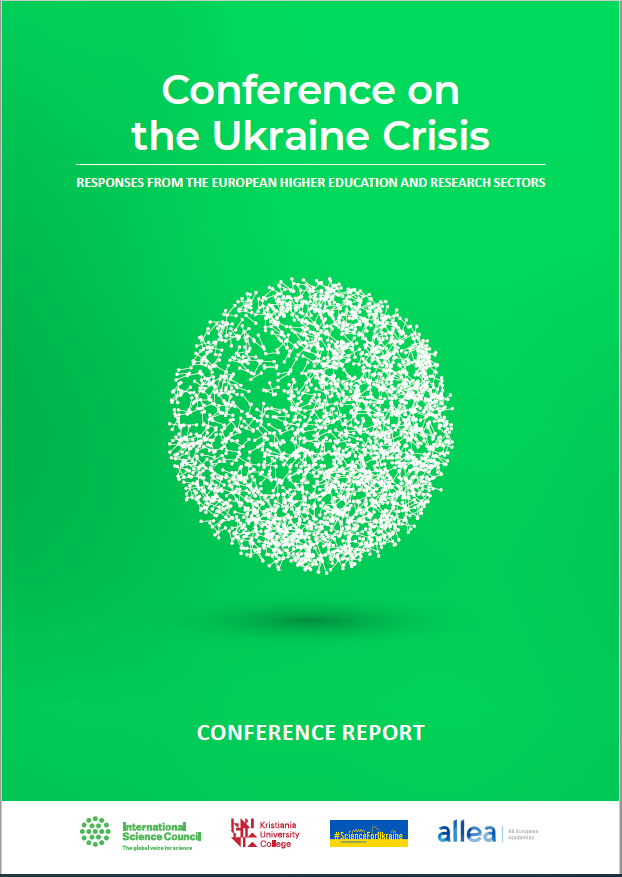
New Report: Responses from the European Higher Education to the Ukraine Crisis

The report includes important lessons and recommendations on how to support the science sector in Ukraine and in other countries affected by conflict and disaster.

The report, published on 31 August 2022, summarises the discussions of the conference ‘The Ukraine Crisis: Responses from the European Higher Education and Research Sectors,’ organised jointly between ALLEA, Science for UkraineKristiania University College and the International Science Council (ISC) in June 2022.

The report highlights 7 key principles for national governments, multilateral organisations and the global science sector to support the academic system in countries that have been affected by conflict:

  1. RESPONSIBILITY: Governments, the higher education, scientific and research community must work together to deliver their national commitments to recognizing and supporting the right to education and science within their country.
  2. INTERNATIONAL SOLIDARITY: Governments, the higher education, scientific and research community must work together to deliver their national commitments for supporting the participation of at-risk, displaced and refugee scholars and researchers in their home country or a third country if necessary.
  3. OPENNESS: The international scientific and research community should empower conflict-affected science systems with the means to rebuild by adopting the UNESCO recommendation on open science.
  4. INCLUSION: All stakeholders must ensure that programmes and opportunities are designed inclusively to avoid exclusion of specific groups of at-risk, displaced and refugee scholars and researchers based on characteristics such as language, family status, gender, disability, cultural background and psychosocial wellbeing.
  5. MOBILITY: Stakeholders must work together to develop global mechanisms and coordination structures that facilitate secure academic and scientific mobility – to ensure the potential of displaced and refugee scholars and students is not lost.
  6. FLEXIBILITY: All stakeholders must recognize the evolving needs of academics, researchers and students by designing more flexible programmatic and funding models that enable changes in location and allow for both remote and in-person participation.
  7. PREDICTABILITY: Stakeholders must work together to develop sustainable frameworks within and between national scientific, higher education and research systems that enable a more predictable and effective approach to the phases of preparedness, response and rebuilding in the aftermath of conflict or disaster.

The conference brought together over 150 stakeholders from across Europe. Over half of the attendees came from Ukraine, including the Minister of Education and Science for Ukraine, the Honourable Serhiy Shkarlet, who delivered a keynote speech. Participants reflected on the assistance provided to-date for academics, scientists, researchers and students who are at-risk, displaced or refugees as a result of the war in Ukraine, and put forward recommendations for mid- to long-term support, including rebuilding of the higher education and research sectors after conflict.

In launching the report, ALLEA President Antonio Loprieno remarked that “we are now six months into the invasion and there is a real need to remind people that the crisis has not gone away, so the report is very timely.” 

The report will be shared at the forthcoming Science|Business Network Conference ‘United Europe: Widening R&I cooperation in times of war’, which will take place on 7 September 2022.

Download the conference report

Conference on the Ukraine Crisis: Responses from the European Higher Education and Research Sectors

The Ukraine Crisis: Responses from the European Higher Education and Research Sectors

On 15 June 2022, ALLEA co-organised the online conferenceThe Ukraine Crisis: Responses from the European Higher Education and Research Sectors.’ The event brought together key stakeholders in Europe to address the impact of the war in Ukraine to the country’s academic and scientific sectors.

The conference was organised jointly by ALLEA and Science for UkraineKristiania University College and the International Science Council (ISC). Invited guests included members of the higher education and research sectors, relevant government bodies, funding and donor agencies, and humanitarian organisations. The event also sought to serve as a platform for Ukrainian voices, with many Ukrainian scientists and institutions participating actively throughout the conference and in the subsequent breakout sessions.

The conference was opened with a presentation from the Ukrainian Minister of Education and Science, Serhiy Shkarlet, who outlined the current challenges and prospects facing the Ukrainian academic sector. Minister Shkarlet emphasised the importance of renovating the Ukrainian higher education system and preventing a brain-drain, which could have a long-term detrimental impact on Ukrainian science.

Minister Shkarlet’s presentation was followed by a roundtable discussion composed of Ukrainian displaced scholars who remained in the country, as well as early-career Ukrainian scientists, European and global scientific institutions, NGOs, and the international humanitarian sector. The main topics of discussion included how to best support scientists who stayed in Ukraine, and the importance of finding a balance between short- and long-term strategies. Also covered in the discussion were the immediate needs of Ukraine’s higher education sector, which include critical equipment to continue operations, and technical support to digitalise the education system and transition to an online presence with opportunities for distance learning, joint degrees and affiliations, all of which are needed to remain active through the war.

ALLEA was represented by its Vice President, Professor Luke Drury, who introduced ALLEA’s response to support Ukraine. These include the newly established European Fund for Displaced Scientists (EFDS), which recently launched its call for applications for Funding Line 1, and ALLEA’s participation in drafting a 10-point Action Plan to support the Ukrainian academic system.

The round table was followed by four breakout sessions which aimed to identify solutions and recommendations pertaining to ongoing support and rebuilding of Ukraine, including existing support initiatives, short- and long-term interventions, and lessons learned to respond to similar situations in other regions of the world.

ALLEA Signs 10-Point Action Plan to Support Ukrainian Academic System

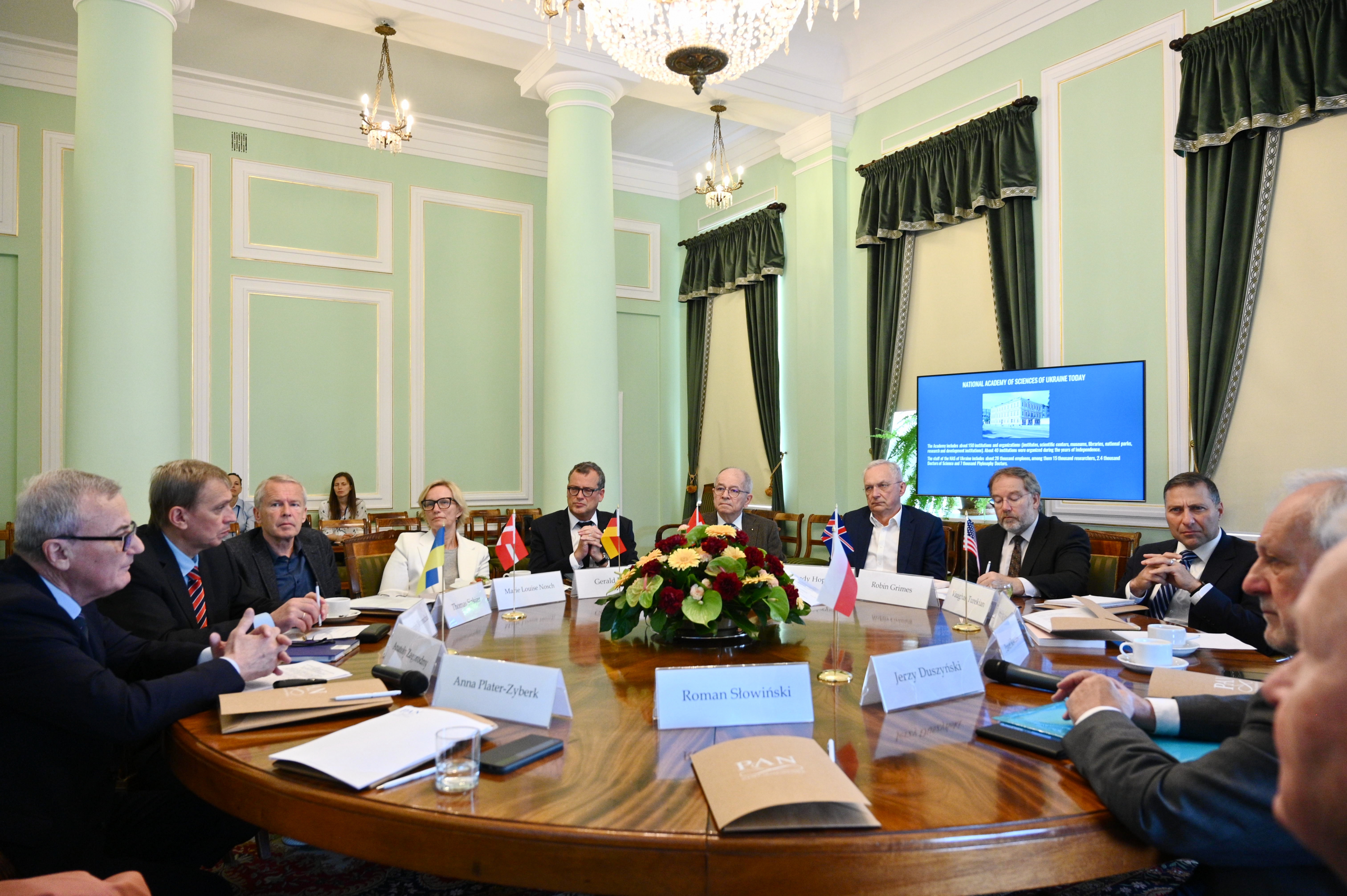
Following a meeting of representatives from various scientific institutions on 2 June 2022 at the Polish Academy of Sciences in Warsaw, a 10-point Action Plan has been unveiled to help Ukrainian science, both during and after the war.

The main goal of the meeting was to inform relevant stakeholders about ongoing schemes to support the Ukrainian academic system and the members of the scientific community that have been impacted by the war, as well as to coordinate the use of resources in order to allocate them more efficiently.

The Action Plan takes into consideration means to maintain the Ukrainian academic system operating throughout the duration of the war, as well as provisions for the recovery of a post-war Ukraine.

The Action Plan was signed by ALLEA President Antonio Loprieno, and by representatives from the the Polish Academy of Sciences, the National Academy of Sciences of Ukraine, the US Academy of Sciences, the German National Academy of Sciences Leopoldina, the Royal Danish Academy of Sciences and Letters, and the Royal Society of the United Kingdom.

Read the 10-point Action Plan