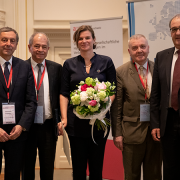
Mariana Mazzucato receives the 2019 Madame de Staël Prize

Mariana Mazzucato, Professor in the Economics of Innovation and Public Value at the University College London (UCL), honoured with the 2019 All European Academies Madame de Staël Prize for Cultural Values in Bern.

Economist Mariana Mazzucato was awarded the 2019 All European Academies Madame de Staël Prize for Cultural Values in Bern yesterday to honour her wide-ranging and stimulating work in the field of political economy and particularly her original contributions to understanding the role of the state in innovation. The Prize, endowed with €20,000, is supported by the foundation Compagnia di San Paolo.

Mazzucato is the sixth scholar to receive this prize, which was established in 2014 to commemorate a deep-rooted understanding of European culture as connected by an inherent diversity supported by a dynamic and vigorous intellectualism.

From left to right, Francesco Profumo (Compagnia di San Paolo), Antonio Loprieno (ALLEA), Mariana Mazzucato (University College London), Jean-Pierre Bourguignon (European Research Council), Guy Parlemin (Federal Councillor).

Antonio Loprieno, ALLEA President and chairman of the Prize jury, praised the distinctive career of Mazzucato. “Her scholarly work is characterised by both ingenuity and vision. With a thorough and incisive analysis, she has dug into the understanding of innovation, shedding light on the interplay between the state, business and research in our modern economy. Reminiscent of the critical mind shown by Madame de Staël, the jury honours Mazzucato as an outstanding scholar who is both helping to shape new narratives for Europe while strengthening our common values.

The award ceremony took place on the occasion of the 25th anniversary of ALLEA, the European Federation of Academies of Sciences and Humanities, during a solemn session hosted by the Swiss Academies of Arts and Humanities at the University of Bern. Mazzucato received the prize from the hands of Swiss Federal Councillor Guy Parmelin. The ceremony was introduced by Francesco Profumo, President of the Compagnia di San Paolo, and Jean-Pierre Bourguignon, President of the European Research Council, who delivered the laudatory speech.

ALLEA 25th Anniversary: Livestream available

ALLEA and the Swiss Academies of Arts and Sciences will provide a livestream for the events taking place on the occasion of the ALLEA 25th Anniversary on 8-9 May 2019 in Bern.

The events that will be available via livestream include the jubilee speeches and the Madame de Staël Prize for Cultural Values award ceremony to be held on 8 May, as well as the four different sessions of the scientific symposium ‘Science and Society in Present-day Europe’ which will be taking place on 9 May.

The livestream will be accessible on 8 May from 18:00 to 20:00 and on 9 May from 10:30 to 17:30 through this link. You can check the full programme of activities for the ALLEA 25th Anniversary celebrations here, and the full list of speakers here.

ALLEA experts discuss new editorial series ‘Europa’ in Rome


A new book series of the ‘Europa’ editorial delves into the legal, political, scientific, cultural and social dimensions of the European utopia and its future. ALLEA, jointly with its Member Academies, contributed to the discussion of the first three volumes in a conference that complements the series ‘Europe on Test

During a conference hosted by the Accademia dei Lincei on 26 March 2019, the Istituto della Enciclopedia Italiana Treccani presented its latest publication ‘Europa’: an editorial series in three volumes.

The event was organised with the participation of ALLEA. International speakers from its Member Academies discussed the initiative in general, and each of the volumes respectively.

Honoured by the presence of the President of the Italian Republic Sergio Mattarella, Günter Stock (past ALLEA President) welcomed the participants on behalf of ALLEA. In his speech, he congratulated the editors to a very well-composed publication and to stirring a debate that could not be timelier and more important, not least given the events around the United Kingdom’s attempt to leave the European Union. Referring to the title of the first volume (’Un’utopia in costruzione’), he said:

“As such it [Europe] entails visionary ideas, very hard work, constant reflection and readjustment, as well as an enormous amount of exchange and debate by all of its constituencies – to form a whole that is far greater than the sum of its parts. Utopia should lead to vision, visions should encourage strategic plans, and, most importantly, strategic plans must be complemented by concrete plans for implementation and action.”

‘Europa’ in three volumes

His welcome address was followed by the presentation of the three volumes. Each one was discussed by an Italian scholar, as well as an international discussant representing ALLEA. The first volume focuses on the political, institutional, legal and economic issues that affect the European Union and was discussed by Dame Helen Wallace (British Academy).

The second volume concentrates on the topics of scientific research, technology, infrastructure and innovation policies and was discussed by ALLEA Board Member Pere Puigdomènech (Royal Academy of Arts and Sciences of Barcelona and Institut d’Estudis Catalans).

The third volume deals with socio-cultural aspects, as well as the major social changes that have made possible the unification of Europe and was discussed by Michael Rössner (Austrian Academy of Sciences).

A live video recording of the conference is available here.

Conference Series

The conference complements the ALLEA conference series ‘Europe on Test: Narratives of Union and Disunion, organised under the patronage of ALLEA and hosted by selected Academies of Sciences and Humanities in various European cities. Its aim is to address from a variety of disciplinary perspectives the different historical and contemporary socio-political developments that may pose a challenge for the future of Europe as a community.

The upcoming two conferences will take place in Warsaw (11 October) and Torino (7-8 November).

For more information on the ALLEA conference series “Europe on Test” see www.allea.org/europe-on-test-narratives-of-union-and-disunion/

ALLEA, EUA and Science Europe publish joint statement on academic freedom and institutional autonomy


ALLEA, EUA and Science Europe call to protect academic freedom and safeguard institutional autonomy by providing and honouring sound regulatory frameworks

ALLEA, the European University Association (EUA) and Science Europe issued a joint statement today on the urgent need to back commitments to academic freedom and university autonomy with solid actions. The three partners, representing a vast section of Europe’s research and higher education system, maintain that academic freedom and institutional autonomy are of fundamental importance and value to society.

“Our knowledge-based societies are dependent on scientific progress, but the fragility of the core principles of academic life, freedom and autonomy, are often disregarded. Only with them can science best serve society”, said Antonio Loprieno, President of ALLEA. “Recent developments in Europe with growing political pressure in certain countries have made us painfully aware of the need to protect these values at all costs. It is time for scientists, but also society at large, to stand up against unjustified infringements and to call for stronger safeguards.”

The statement calls on governments and public authorities to protect academic freedom and safeguard institutional autonomy by providing sound regulatory frameworks and refraining from interference in the internal affairs of higher education and research institutions. It also urges them to guarantee scholars and students the rights that constitute academic freedom, such as freedom of expression, opinion and thought.

Furthermore, the three organisations call on universities, funding agencies, academies and other research organisations to foster a culture in which free expression and the open exchange of opinion are valued and the academic freedom of researchers, teachers and students is safeguarded.

“Recent developments in Europe with growing political pressure in certain countries have made us painfully aware of the need to protect these values at all costs. It is time for scientists, but also society at large, to stand up against unjustified infringements and to call for stronger safeguards.”

Antonio Loprieno, ALLEA President

Universities and academies have recently been the target of increased political pressures. The European Parliament triggered a disciplinary procedure to determine if democratic values, including academic freedom, have been undermined in Hungary. In 2018, the government banned the teaching of gender studies and forced the Central Europe University to relocate most of its activities outside the country.

Following a lengthy dispute over budget matters with the Hungarian government, the Hungarian Academy of Sciences, recently had to begrudgingly agree to a reform of its research institutes, which places the institutes under a new governing body made up of both academicians and scientists, but chaired by an appointee of the prime minister. In Turkey, the academic sector has come under increased pressure after the 2016 coup attempt, with thousands of public employees being dismissed from their jobs, including academics from ALLEA membership and higher education administrators.

ALLEA has intervened with a range of actions, including mediation, statements and open letters, in support of academic institutions under threat over recent years. The present statement, and the partnership with EUA and Science Europe, is a call to action and reflects the organisations’ shared concern that academic freedom and institutional autonomy are no longer self-evident in Europe and around the world, with grave consequences for scholars, science and society.

Read the full statement here.

Economist Mariana Mazzucato, Winner of the 2019 Madame de Staël Prize

The jury praised her novel thinking, challenging conventional wisdom in the understanding of the role of the state in public policy and innovation.  The prize worth €20,000, with the support of Compagnia di San Paolo, is awarded annually by ALLEA, the European Federation of Academies of Sciences and Humanities, to eminent scholars and intellectuals whose work represents a significant contribution to the identity and values of Europe.

ALLEA submits feedback to Plan S

 ALLEA has submitted feedback to the implementation guidance of Plan S put forth by cOAlition S in late 2018. Feedback on the implementation guidance has now closed.

In order to promote a discussion of the likely impacts of Plan S and to help shape the future of open access, ALLEA has submitted its feedback to the ‘Guidance on the Implementation of Plan S’. The guidance represents a preliminary framework for the adoption and implementation of open access with the final aim of making scientific research and publications more easily accessible to the broader public.

While ALLEA supports open access as a major step towards realising the universality of science, there are many issues that still need to be taken into consideration in order to prevent unintended consequences in the scientific publishing sector and the research evaluation system.

The implementation guidance was proposed by cOAlition S, a consortium of national research funding organisations and charitable foundations with the support of the European Commission and the European Research Council. Plan S requires that, from 2020, scientific publications that result from research funded by public grants must be published in compliant Open Access journals or platforms.

Initial ALLEA Response to Plan S

In an initial response published on December 2018, ALLEA welcomed the ambition of cOAlition S to move the scientific publishing system towards open access. However, ALLEA emphasised that broader consultation with all parties is required during the implementation phase. Moreover, concurrent reforms of the systems for research evaluation and career progression are needed to minimise unintended consequences of Plan S for early career researchers and specialised disciplines.

In addition, the response provided comments and recommendations regarding various implications of Plan S concerning ethics and trust in science, the research evaluation system, the protection of intellectual property rights as well as economic considerations.


ALLEA meeting with cOalition S

ALLEA has engaged with different stakeholders to promote open access and to discuss the future of Plan S. On 4 February, ALLEA’s President, Professor Antonio Loprieno, met in Brussels with Robert-Jan Smits, Open Access Envoy of the European Commission, and Marc Schiltz, President of Science Europe, to discuss the next steps of Plan S.

Seeking to promote a discussion on the topic, ALLEA Member Academies are also opening the debate within the research community at the national level. The International Science Council published an interview with Professor Luke Drury, member of the ALLEA Board and lead author of ALLEA’s response paper, where he elaborates on the importance of Plan S to ALLEA and the broader European research community.

ALLEA reinforces its calls to protect the institutional autonomy and academic freedom of the Hungarian Academy of Sciences

In response to the ongoing and severely threatening infringements by the Hungarian government on the Hungarian Academy of Sciences, ALLEA has published today a statement calling to protect the institutional autonomy and academic freedom of the academy.

Read the full statement

ALLEA 2019 General Assembly: Registration is now open

You can now register to participate in the 2019 ALLEA General Assembly, which will be hosted by the Swiss Academies of Arts and Sciences on 8-10 May in the city of Bern. On this occasion, we will also celebrate the 25th anniversary of ALLEA.

The ALLEA General Assembly convenes academies of sciences and humanities from 40 countries across the Council of Europe region. The General Assembly programme consists of various parts: the annual business meeting, the award ceremony of the All European Academies Madame de Staël Prize for Cultural Values, as well as a Scientific Symposium.

Under the theme Science and Society in Present-day Europe, leading academics, policy-makers and civil society representatives will reflect on the future of European science and the role of academies as bridges between the production and diffusion of knowledge for the benefit of society.


Programme Overview


8 May

ALLEA 25th Anniversary

ALLEA will celebrate its 25th anniversary in the opening of the 2019 General Assembly with a special address on the role of academies in European societies by ALLEA President Antonio Loprieno at the University of Bern. On this occasion, Director-General for Research and Innovation Jean-Eric Paquet will deliver a keynote to commemorate 25 years of European academies’ cooperation and reflect on the future of European research.

Madame de Staël Prize Award Ceremony

The ALLEA Madame de Staël Prize for Cultural Values is annually awarded to an eminent scholars and intellectual whose work represents a significant contribution to the cultural values of Europe and to the idea of European integration, thereby promoting and strengthening an understanding of Europe as multifaceted, intellectual, open and vibrant. The 2019 laureate will be announced shortly and will receive the award during a ceremony hosted by the University of Bern.


9 May

Scientific Symposium: Science and Society in Present-day Europe

Public confidence in the guiding role of science in shaping our future seems to be increasingly called into question. Does European science blossom, while European societies ache? Political discourse is frequently driven by algorithms of acceptance rather than by scientific or scholarly expertise. Our common cultural values, rooted in the curiosity and tolerance of the Enlightenment, are increasingly challenged.What role can European academies play to provide a bridge between production and diffusion of knowledge to and with society? The scientific symposium Science and Society in Present-day Europe will discuss these and other issues through four dedicated sessions on Science Policy, Early Career Researchers’ Perspective, Science in Society, and Science Advice.

Speakers will include Jean-Pierre Bourguignon, President of the European Research Council ERC; Madeleine Herren-Oesch, Director of  the Institute for European Global Studies, University of Basel; and Lesley Wilson, Secretary General of the European University Association (EUA).

Berne Scientifique: Guided scientific tour through the city of Bern

Throughout the years, Bern has proven to be a scientifically important city. Even Albert Einstein got the inspiration for his revolutionary theory of relativity in this very place. You will explore this place from an unconventional perspective. So, let us stroll through the alleys of this mesmerising and historic city and enjoy dinner in a surprising location.


10 May

Visit to Basel: One-day trip to the scientific and cultural facilities of Basel

The trip to Basel will start with a visit of the unique architecture of the Novartis campus, composed by architectural masterpieces by Marco Serra, David Chipperfield and Frank Gehry. The excursion continues with a guided tour of the Novartis campus’ laboratories, a walk around the historic centre of Basel and a tour of the Swiss Tropical and Public Health Institute, where an aperitif will be provided. The visit to Basel will incur a cost of €50 to cover all transportation, meals and entrance fees.


Attendance to the General Assembly is free of charge, but registration is mandatory for all participants. If you wish to register, please refer to the registration page at the ALLEA General Assembly website.

To Registration Page

To General Assembly Website


Organisers


Partners

Trust in Science in a Digital World: New Mechanisms Needed

ALLEA published the discussion paper “Trust in Science and Changing Landscapes of Communication” today. The paper examines how the increasing use of social media and other digital transformations affect and challenge trust relations between science, media and society.


In response to these challenges, the paper discusses the development of new tools for fact-checking and quality control of scientific information online. The authors urge political leaders to back and value scientific methods and standards of research integrity, and support digital innovations to overcome threats to public reasoning and scientific discourse.

While the widespread use of social media as a source of information might lead to a ‘context collapse’ of information, reinforce people’s confirmation biases and ultimately push the polarisation of societal groups through so-called ‘echo-chambers’ and ‘filter-bubbles’, the paper warns about a growing corporatisation of communication, a lack of funding for quality science journalism, (geo-) political computational propaganda and disinformation campaigns, as well as an increasingly polarised political climate.

All these trends have substantial consequences for the communication of science and might threaten the core pillars of trust in science as well as media: integrity, transparency, autonomy and accountability. The paper proposes to develop new mechanisms for researchers, journalists and other communicators of research to safeguard and reinforce these pillars and counter a loss of trust and trustworthiness.

Researchers “need to convincingly prove that a free and just society means a society in which all people are equal, but not all expressions are equally true. It is a society in which everyone should have unrestricted access to data and information, but also the opportunity and civic duty to acquire the skills needed to evaluate knowledge claims. This is why it is crucial to reflect on how we can effectively organise and defend a democratic digital society in which trust in expertise is anchored in longstanding and well-established standards – but wrapped in new mechanisms.”

The paper considers that researchers “need to become even more transparent, more ‘observable’, and more public than before”, engage in online debates regarding their field of expertise and “guide non-experts by systematically deconstructing and refuting deceitful stories and outright fabrications”. “Automated tools for fact-checking, flagging, online linking and referencing have to be developed and carefully tested in order to help citizens identify quality information”, the authors argue.

However, as the paper concludes, there are limits to what a good-hearted and motivated scientific community can do to overcome the identified obstacles by merely improving its (digital) communication. Without a supportive political backing that values scientific methods and standards of research integrity, and effectively protects science and society from the threats identified in this paper, “all well-meaning efforts might come to naught and look like bringing origami flowers to a machine-gun fight.”

Download Publication

Note to Editors

The discussion paper reflects the conclusions of a workshop held by the ALLEA Working Group “Truth, Trust & Expertise” at the Royal Netherlands Academy of Sciences and Arts in Amsterdam in August 2018. The expert group, chaired by Baroness O’Neill of Bengarve and Professor Ed Noort, is a transnational platform for perspectives on the nature and relationship between truth, trust and expertise in the field of science and research.

The discussion paper “Trust in Science and Changing Landscapes of Communication” and all preceding issues can be found here.

For press inquiries, interviews with experts or requests of hard copies please contact Susana Irles (irles@allea.org).

For content related inquiries please contact Daniel Kaiser (kaiser@allea.org).


Related Event

ALLEA and Re-Imagine Europa have organised the international forum “Democracy in a Digital Society – Trust, Evidence and Public Discourse in a Changing Media Environment”, taking place on 24 January, at the Berlin-Brandenburg Academy of Sciences and Humanities. On this occasion, Baroness O’Neill of Bengarve and Professor Christiane Woopen will discuss the findings of the ALLEA Working Group Truth, Trust and Expertise with a wider audience alongside contributions by EU Commissioner Mariya Gabriel, Manuel Castells and other prominent speakers from policy, academia and civil society.

For further information on the event and a livestream please click here.

ALLEA publishes second Discussion Paper on Loss of Trust in Science and Expertise

The ALLEA discussion paper “Trust Within Science: Dynamics and Norms of Knowledge Production” is now available. It was drafted by experts from the ALLEA Working Group Truth, Trust and Expertise.

The publication reflects on some specific approaches that academic research can adopt towards the common goal of producing reliable, reproducible and trustworthy scientific evidence. It also takes a normative stance by reaffirming the need for more articulated and context-sensitive standards of research integrity, greater and better inter-, multi- and transdisciplinary collaboration, re-adjustments in the evolving system of scientific publishing, and the importance of ethical guidance as a shaping asset for trustworthy research.

The paper thereby seeks to understand and value the different methodological approaches that inform knowledge production. How can different scientific disciplines trust and learn from each other? Are there common research standards that are clearly shared by all disciplines and constitute the ‘backbone’ of scientific practice? How can these standards be effectively communicated to a wider audience? These are the questions addressed in this  issue.

The publication follows the ALLEA discussion paper Loss of Trust? Loss of Trustworthiness? Truth and Expertise Today, which focused on how trust in expertise is placed or refused more generally.


Download Publication