
TRANSITIONING TO SUSTAINABLE FOOD SYSTEMS
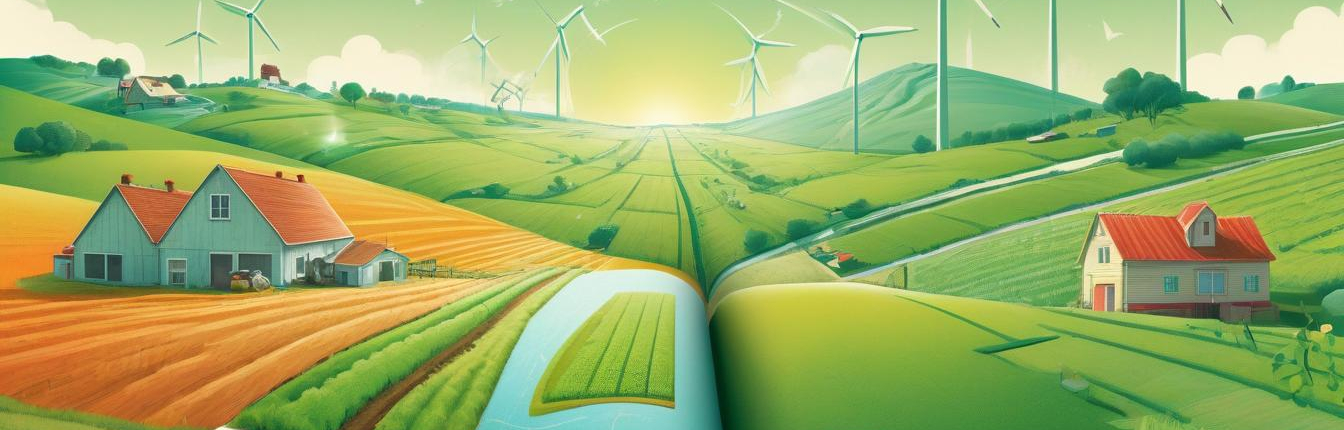
Developing sustainable food systems is an existential and complex issue. There are several interconnected goals to consider – feeding a growing population, ensuring food safety and security, promoting environmental sustainability, safeguarding rural communities’ culture and way of life, and enabling technological innovation and economic progress – which can sometimes appear to be in conflict with one another. But the stakes have never been higher. Europe urgently needs more sustainable and secure food systems to respond to accelerating environmental degradation, economic uncertainty, geopolitical volatility, and rapid societal change. At the same time, the debate on how to get there grows ever more polarised, reinforcing biases and deepening social divides within communities.
As part of an inter-organisational Task Force on Sustainable Food Systems and Innovation, led by Re-Imagine Europa, ALLEA has been working on different aspects of the transition to sustainable food systems in Europe, with the primary objectives of the Task Force as follows:
- To develop a shared understanding of what is meant by sustainable food systems, including which values and goals should be prioritised.
- To assess how innovations can support the transition to a European model for sustainable agriculture promoting social, environmental, and economic sustainability, going beyond the debate on NGTs (New Genomic Techniques).
ALLEA Contact
Maria Ronald
Project Manager (CoARA)
ronald@allea.org
Related Activities
New Genomic Techniques
The ALLEA report “Genome Editing for Crop Improvement” presents the state of the art of scientific evidence in the field and explores paths to harmonise EU legislation with recent scientific developments, while particularly considering relevant ethical and societal considerations.
Intellectual Property System for New Genomic Techniques
When considering the potential of New Genomic Techniques (NGTs) for crop improvement, such as genome editing using the CRISPR-Cas technology, (see ALLEA’s work on New Genomic Techniques), the protection of intellectual property (IP) rights is a critical concern.
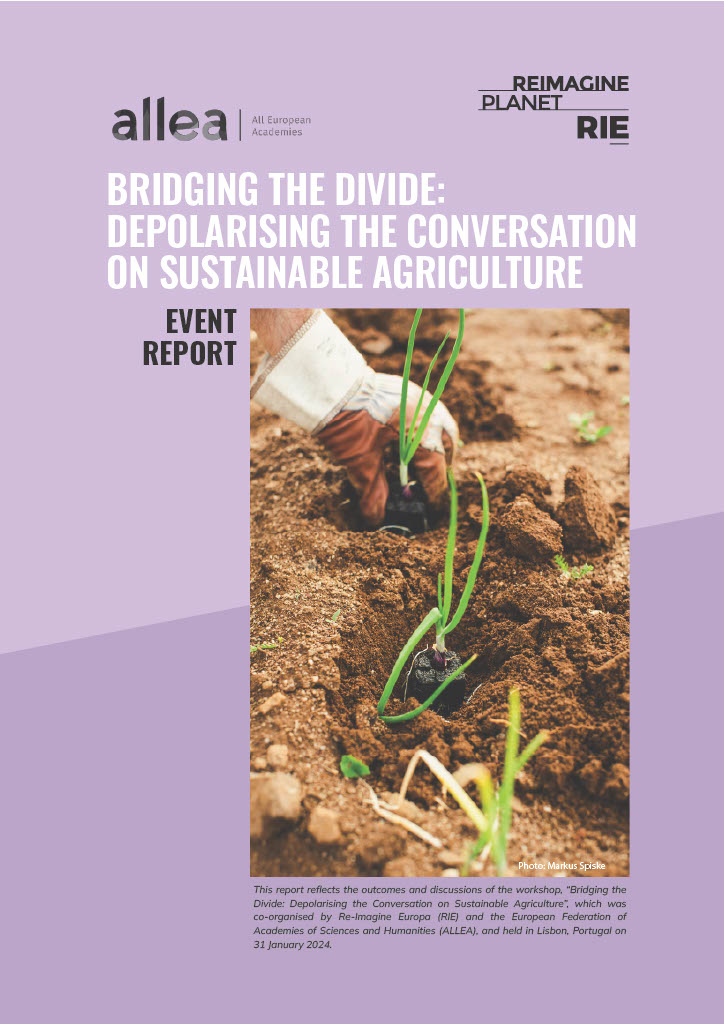 https://allea.org/wp-content/uploads/2024/07/1719919454084-df498c40-8b8e-437c-8695-4d1e2f56e0c0_1.jpg 1024 724 maria ronald https://allea.org/wp-content/uploads/2019/04/allealogo-1-300x83.png maria ronald2024-07-02 14:14:282025-03-07 11:43:42Bridging the Divide: Depolarising the Conversation on Sustainable Agriculture – Event Report
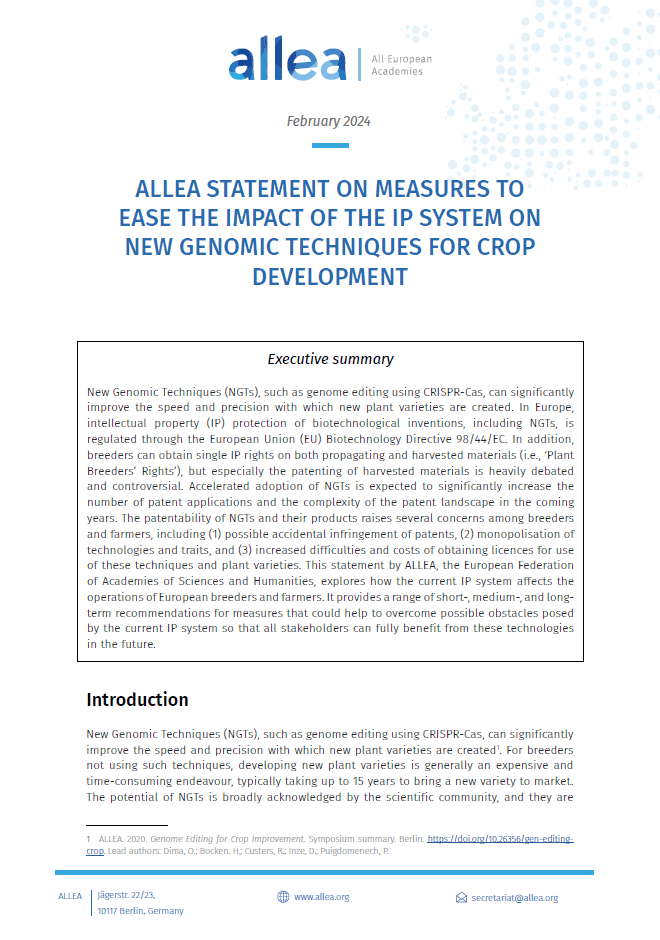 https://allea.org/wp-content/uploads/2024/02/Cover-page-IP-NGT.png 940 660 alleaadmin https://allea.org/wp-content/uploads/2019/04/allealogo-1-300x83.png alleaadmin2024-02-06 10:31:242024-07-29 13:58:09ALLEA Statement on Measures to Ease the Impact of the IP System on New Genomic Techniques for Crop Development
 https://allea.org/wp-content/uploads/2020/10/Cover_publication.png 909 643 alleaadmin https://allea.org/wp-content/uploads/2019/04/allealogo-1-300x83.png alleaadmin2020-10-29 08:56:422020-10-30 14:21:15Genome Editing for Crop Improvement
 https://allea.org/wp-content/uploads/2019/06/Cover_Patent-CRISPR-CAS.png 594 418 alleaadmin https://allea.org/wp-content/uploads/2019/04/allealogo-1-300x83.png alleaadmin2016-06-06 15:02:202021-04-08 12:18:40ALLEA Statement on Patent-Related Aspects of CRISPR-Cas Technology
Related News
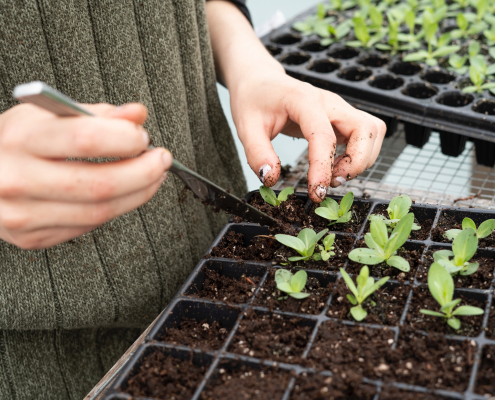 https://allea.org/wp-content/uploads/2022/12/zoe-schaeffer-H0iAXFekiWo-unsplash-scaled.jpg 1707 2560 Dino Tramontani https://allea.org/wp-content/uploads/2019/04/allealogo-1-300x83.png Dino Tramontani2022-12-05 15:17:372022-12-12 13:20:37ALLEA Launches New Task Force to Investigate the Intellectual Property System for New Genomic Techniques
 https://allea.org/wp-content/uploads/2022/06/shutterstock_399452227-Copy-scaled.jpg 1221 2560 Dino Tramontani https://allea.org/wp-content/uploads/2019/04/allealogo-1-300x83.png Dino Tramontani2022-06-22 17:42:012022-06-23 14:34:54ALLEA Provides Expert Advice to the European Commission’s Public Consultation on Plants Produced by New Genomic Techniques
 https://allea.org/wp-content/uploads/2021/10/shutterstock_795615301-scaled.jpg 1672 2560 Dino Tramontani https://allea.org/wp-content/uploads/2019/04/allealogo-1-300x83.png Dino Tramontani2021-10-21 13:50:322022-06-09 12:56:31ALLEA Responds to European Commission Consultation on New Genomic Techniques
Related Events
 https://allea.org/wp-content/uploads/2023/11/Thumbnail_Event_January-26.png 628 1200 maria ronald https://allea.org/wp-content/uploads/2019/04/allealogo-1-300x83.png maria ronald2023-01-26 10:30:342023-11-30 14:59:53Task Group on IP System for New Genomic Techniques Meeting
 https://allea.org/wp-content/uploads/2023/11/Thumbnail_Event_July-22.png 628 1200 Dino Tramontani https://allea.org/wp-content/uploads/2019/04/allealogo-1-300x83.png Dino Tramontani2021-07-22 09:56:512024-03-26 15:28:05Virtual Event: Beyond the Apple of Discord
 https://allea.org/wp-content/uploads/2019/06/shutterstock_103452785medium.jpg 466 700 alleaadmin https://allea.org/wp-content/uploads/2019/04/allealogo-1-300x83.png alleaadmin2019-11-07 15:05:512021-07-08 10:16:00Symposium: Genome Editing for Crop Improvement